
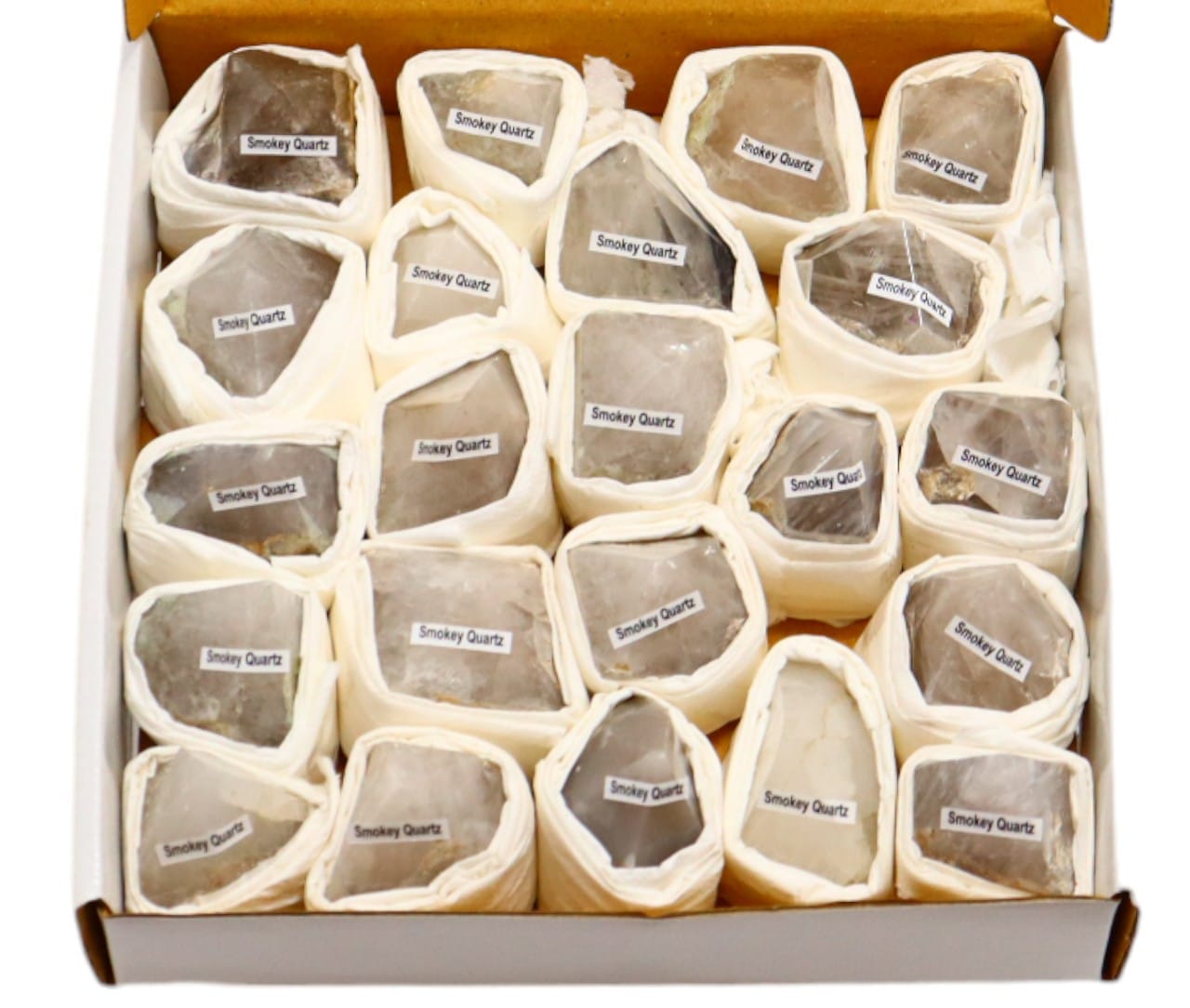
Description
Smoky quartz is a variety of quartz with a color ranging from smoky brown to almost black and is translucent. The darkest varieties are known as morion. It occurs primarily in cavities of intrusive and high-grade metamorphic rocks, while it is rare in sedimentary and effusive rocks. Known localities include the Alps, Brazil, Russia, Mexico, India, Ireland, Zimbabwe, Afghanistan, and the United States. The color of smoky quartz is caused by the presence of aluminum in the crystal lattice, in combination with ionizing radiation. In this process, aluminum replaces silicon in the structure, resulting in the complex [AlO4-] instead of [SiO4]. During crystal growth, small monovalent cations such as hydrogen, lithium, or sodium are incorporated to compensate for the charge difference. Under the influence of ionizing radiation, an electron from the [AlO4-] complex moves to a cation, creating a color center. This process normally occurs below 50°C. At higher temperatures, the color degrades faster than it forms. The source of the ionizing radiation is usually potassium-40 in the surrounding rock. The color of smoky quartz therefore forms long after crystallization and can last millions of years, which explains why it is often found in granite. Above 200°C, smoky quartz loses its color. Irradiating clear quartz with X-rays or gamma rays almost always results in smoky quartz, a method used to transform colorless quartz into smoky quartz. In ancient times, the stone served as a warning to soldiers when it darkened. Today, smoky quartz is still used in religious objects such as rosaries and crucifixes, and it is attributed with various medicinal properties.


