
Description
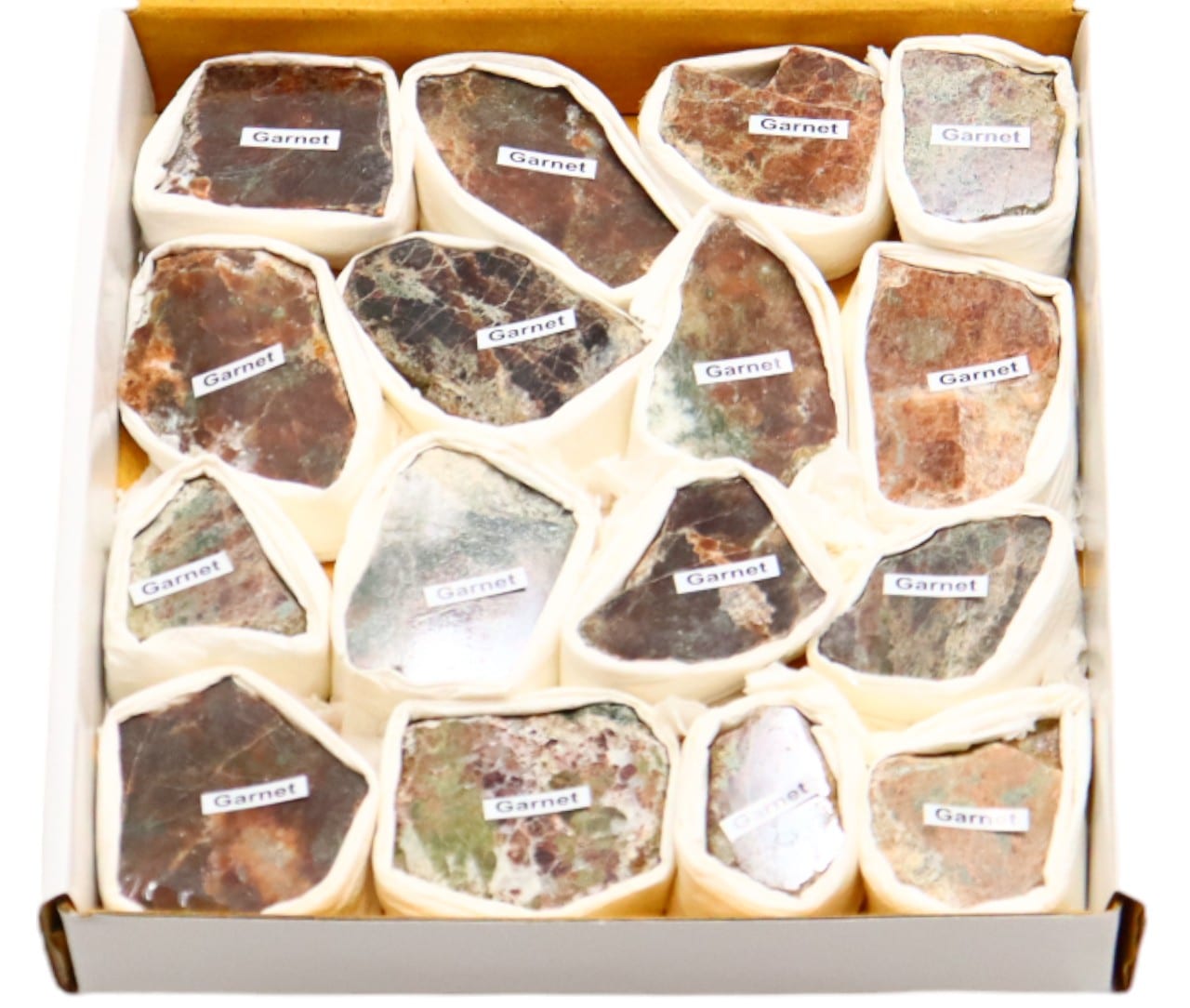
The garnet group includes minerals with a cubic crystal system and crystals in the shapes of rhombic dodecahedra and trapezoids. They are nesosilicates with the general chemical formula A3B2(SiO4)3. Garnets can contain chemical elements such as calcium, magnesium, aluminum, iron(II), iron(III), chromium, manganese, and titanium. They do not exhibit cleavage and have a hardness of 6.5 to 7.5. Garnets can range from transparent to opaque. The term "garnet" comes from the Latin "granatus," referring to "malum granatum" (pomegranate), a plant with red seeds that resemble the commonly found garnet crystals. Contrary to popular belief and what the name suggests, garnets are not always red. They can be purple, red, orange, yellow, green, brown, black, or colorless. In 1998, a blue-pink garnet, a very rare variety, was discovered for the first time in Bekily, Madagascar. The six most common varieties are pyrope, almandine, spessartite, grossular, uvarovite, and andradite, which occur in two solid-solution series: 1. The pyralspite group: pyrope-almandine-spessartite 2. The ugrandite group: uvarovite-grossular-andradite. Garnets are very abundant in the Earth's crust and mantle, making them important for understanding the Earth's chemistry. Garnet is also one of the "nine gems" in the Thai Order of the Nine Gems.


