
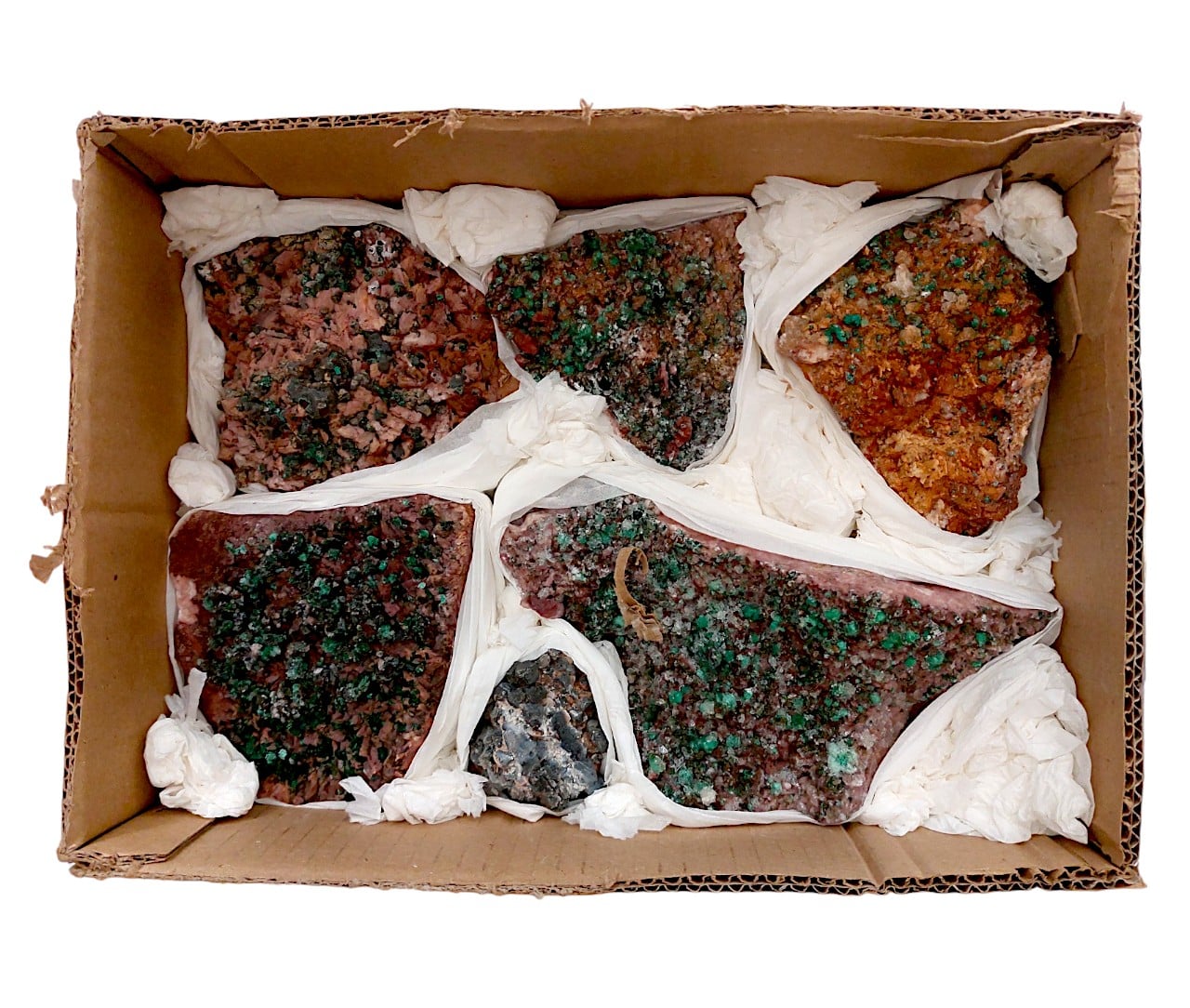
Description
Dolomite, or bitterspar, is a carbonate mineral; calcium-magnesium carbonate with the chemical formula CaMg(CO3)2. Rocks composed largely of this mineral are also called dolomite; to distinguish them, the name dolostone is also used. In its appearance, dolomite resembles calcite, but despite the basic carbonate ion, it dissolves poorly, if at all, in hydrochloric acid. It is not known exactly how the mineral is formed; one possibility is that it occurs in shallow seawater in (sub)tropical regions, but other mechanisms are also possible. Although the rock is not usually formed by sedimentation, it is still considered a sedimentary rock. The mineral owes its name to the 18th-century French geologist Déodat de Dolomieu, who discovered this mineral in the mountain range that has since been named the Dolomites after him. The mineral usually forms secondarily in limestone, where pure calcium carbonate is converted into dolomite. Because Mg ions occupy the spaces of Ca ions in the crystal lattice, voids are created in the rock at both the atomic and macroscale levels. This is typical of secondary dolomite. Dolomite is used as a natural stone, but also as a raw material for cement, as a source of magnesium oxide, and for the manufacture of refractory bricks.


