
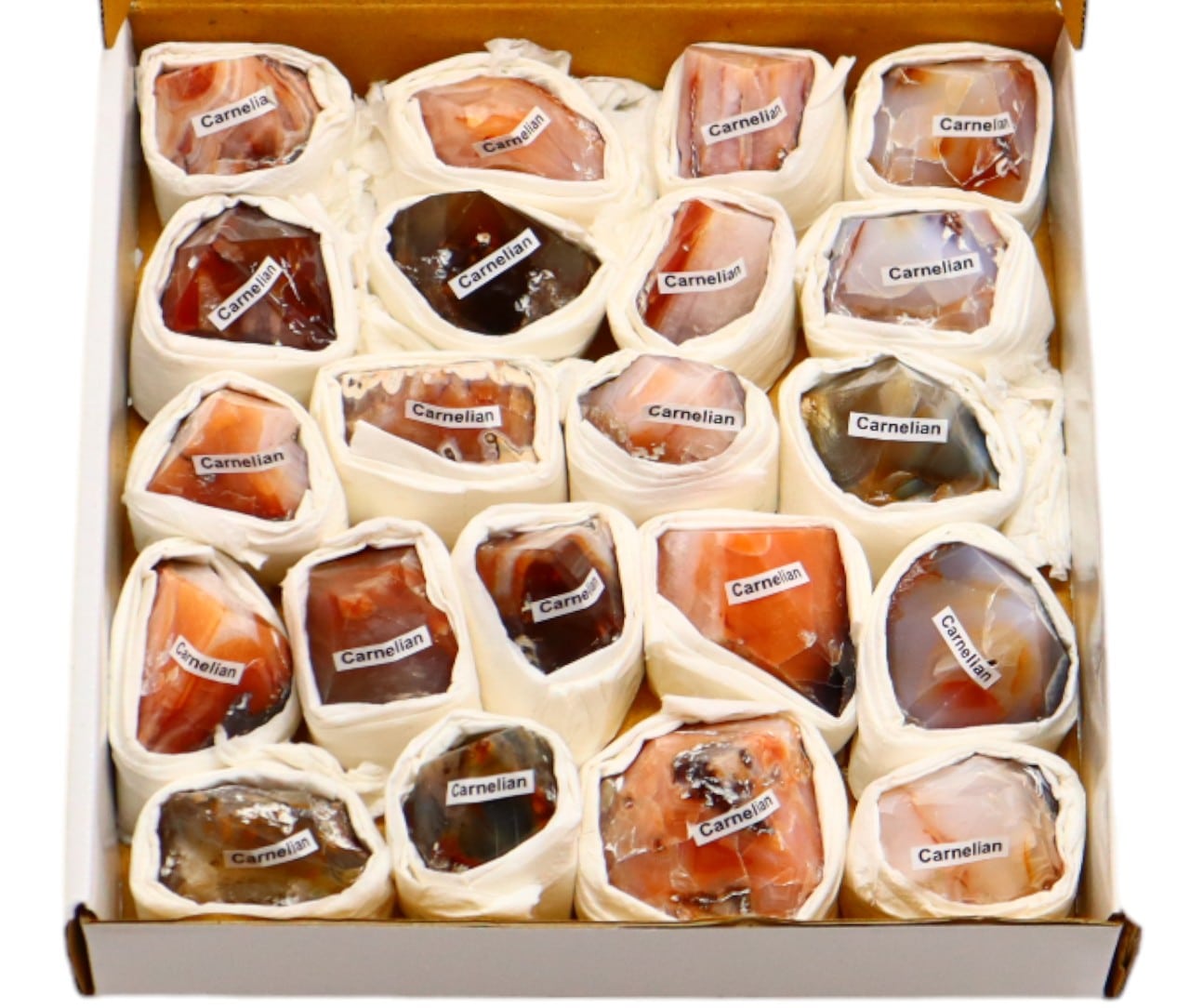
Description
Carnelian is a variety of chalcedony that ranges from flesh-colored to brownish-red, and can be translucent to opaque. It is a type of quartz in which iron, present as small impurities, gives the red color. Heating can intensify this color. The name carnelian comes from the Latin "carnis," meaning "flesh," and in Dutch it was known as cornelian. Even before the Common Era, carnelian was used to make seal stones and jewelry. It was said to offer protection against quarrels, toothaches, and nervous disorders, to stop bleeding, to reduce fever, to calm anger, and to bring good luck. Carnelian forms in volcanic and weathering zones and is found in India, Saudi Arabia, and Egypt. Important deposits are also found in Brazil, the United States, Australia, Russia, the Czech Republic, Germany, and Romania.


