
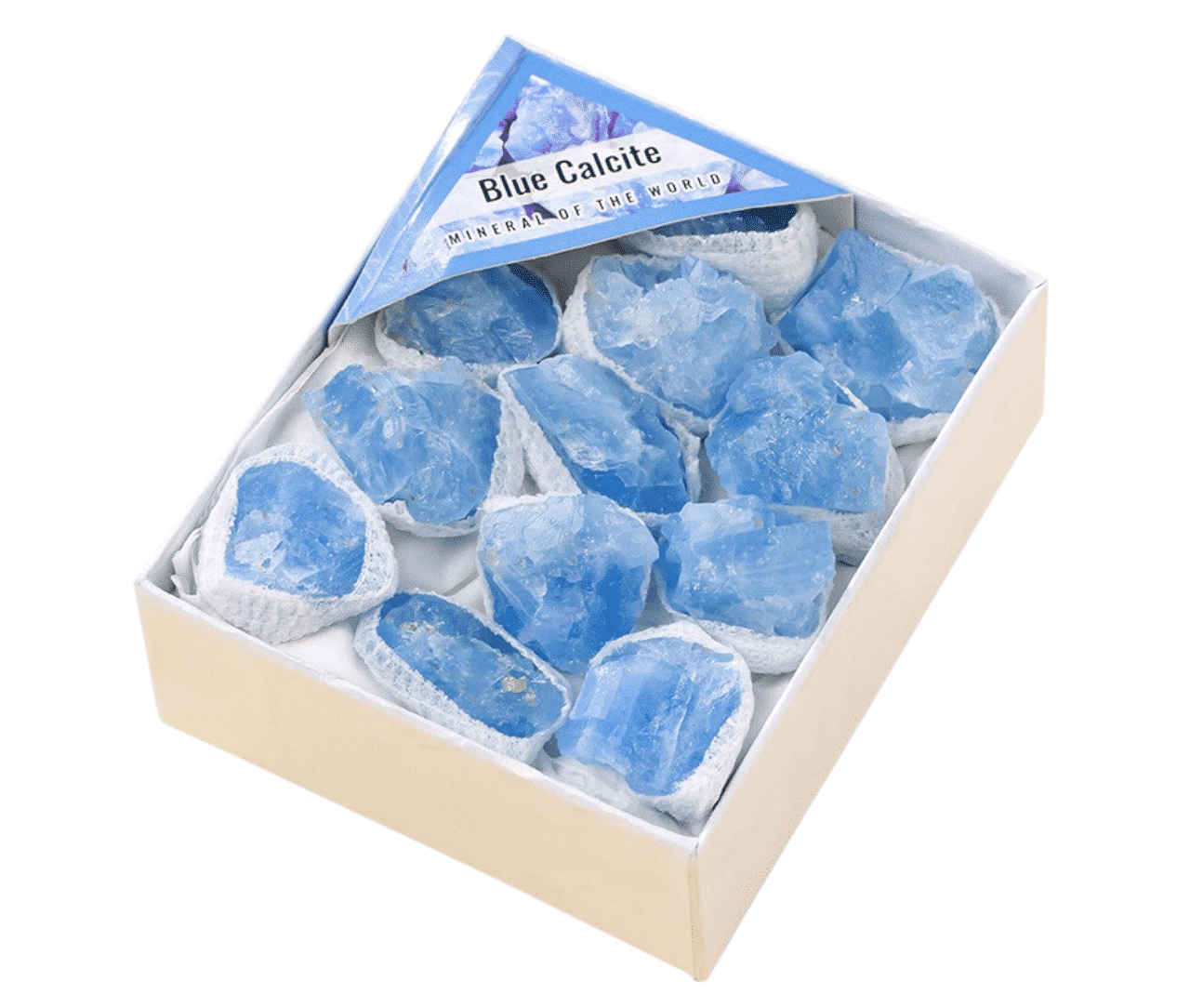
Description
The mineral calcite (also called limespar) consists primarily of the salt calcium carbonate (CaCO3) and is one of the most common minerals in the Earth's crust. Calcium carbonate is formed when soluble calcium ions come into contact with carbon dioxide (forming a carbonate ion if a positive ion is present in a solution). Calcium carbonate is a poorly soluble salt, causing the resulting CaCO3 to precipitate; this occurs according to the following reaction: Ca²⁺(aq) + CO₃²⁻(aq) → CaCO₃(s). Calcite has a trigonal crystal system and belongs to the space group R-3c. A very pure form of calcite is also called bispar due to the birefringence of light in this mineral. It has a rhombohedral structure and is sometimes found as rhombohedral prisms, but it also frequently occurs in other forms, such as scalenohedra, or in fibrous, granular, or compact forms. The crystal structure is primarily a function of temperature, the degree of supersaturation in the crystal's immediate vicinity, and the CO₂ pressure. The calcite structure is the stable modification of CaCO₃ at room temperature. Another form, aragonite, transforms into calcite at 743K. In its pure crystalline form, calcite is clear, colorless, and translucent, but due to impurities (such as copper or sodium salts), it can take on a variety of colors, including gray, blue, violet, green, and even black. It is often also opaque white. The mineral can exhibit both phosphorescence and fluorescence. Its hardness is defined as 3. Calcite is highly birefringent. This optical property was first described by Rasmus Bartholin when the Icelandic form of the mineral, which consists of large, crystal-clear rhombic rhombohedral elements, became available. Christiaan Huygens provided the first explanation with his wave theory of light. Calcite is a common constituent of sedimentary rocks, veins, and deposits in hot springs and caverns in karst regions (as stalactites). It is the mineral that forms limestone and thus the most abundant mineral of biological origin. Calcite is the main component of limestone, chalk, and marble, and is also an important component of marl, calcareous sandstone, and limestone. Calcite is responsible for chemical weathering in igneous and metamorphic rocks, creating sedimentary rocks. Calcite is soluble in CO₂-containing water under slight pressure. As it falls into the air, rainwater absorbs the gaseous carbon dioxide, making it acidic. This acidic rainwater is capable of dissolving lime. In underground currents, this material can be transported in solution until, upon contact with atmospheric pressure, CO₂ escapes and the calcite precipitates. This is how stalagmites and stalactites are formed in caves.


