

Description
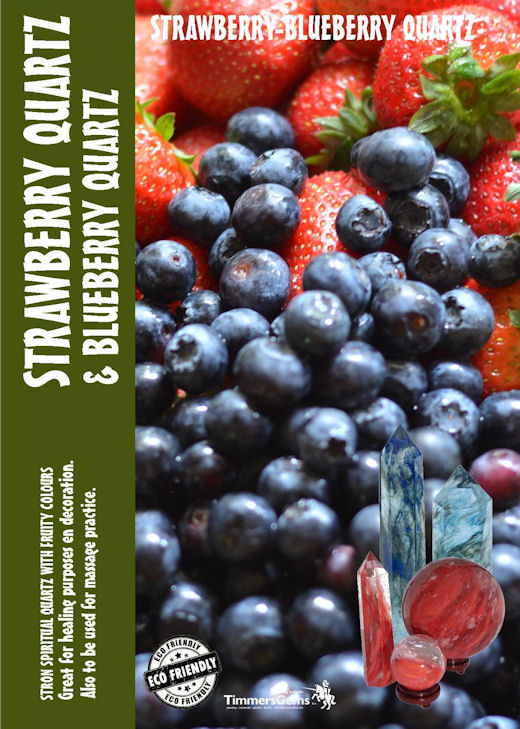
Fruit Quartz is the general term for a group of colorful, translucent materials known individually by fruit-like names such as "cherry quartz," "blueberry quartz," "strawberry quartz," "kiwi quartz," "pineapple handle quartz," and so on. They are often used in jewelry as beads or pendants, or in decorative objects.
Quartz is a form of silicon dioxide, SiO2, and is one of the most common minerals in the Earth's crust. It represents more than 12% of the Earth's crust by volume (found in granite and sand, among other places). Quartz has two modifications: α-quartz is trigonal, and β-quartz (a higher-temperature form) is hexagonal. Silicon dioxide also occurs in many other structures, such as α- and β-cristobalite, keatite, tridymite, coesite, stishovite, melangophlogite, and lechatelierite. Although quartz consists of silicon dioxide, it is often classified as a tectosilicate. This is because quartz forms a network of SiO4 tetrahedra, with each oxygen atom shared by two silicon atoms. Individual SiO2 molecules only occur in gaseous silicon dioxide. Quartz can be very pure, as in rock crystal, but often contains impurities. These impurities can consist of ions that are incorporated into the crystal lattice during crystal growth. Quartz crystals can contain between 13 and 15,000 ppm Al3+, between 9 and 1,400 ppm Na+, between 3 and 300 ppm K+, and traces of Fe3+, Ti4+, P5+, H+, and Li+. Aluminum and iron, in combination with ionizing radiation, are responsible for the color of some quartz varieties. Furthermore, quartz crystals can grow over other minerals, as is the case with rutile quartz. Quartz can form both large crystals and microscopic aggregates. The largest quartz crystals are found at Verloren Farm in Namibia. Quartz crystals up to 20 meters, and possibly 50 meters, and dolomite crystals up to 2 meters are found there. When quartz is melted, it often forms a glass upon rapid cooling, as the crystallization process takes a considerable time. Quartz is a piezoelectric material and the vibrations that can be generated in the crystal lattice


