


Description
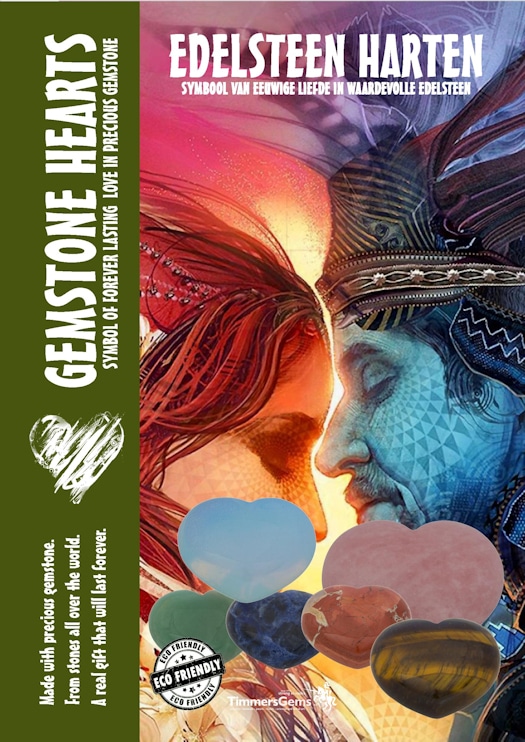
The heart is a very ancient symbol of love used by everyone worldwide. Traditionally, the heart has been chosen in several cultures as the seat of love and emotion. Why the heart was chosen as a symbol of love is not entirely clear. Perhaps because the heart is automatically associated with (emotional) life, and without the heart (read: love), life is not possible. The heartbeat is also influenced by emotions; for example, our heart beats faster when we are in love. The heart wants to be loved. The heart needs love. It is even said that love extends life expectancy, while loneliness has the opposite effect. Everyone knows the expression: "He died of a broken heart.".
Rose quartz (Stone of Love) is a variety of quartz. The color ranges from dark pink to a very light, translucent pink. Rose quartz, named for its pink color, is often cracked and usually slightly cloudy. The colorants are titanium and manganese. The color can fade; very small rutile needles create a six-rayed star shape in cabochon cuts. Rose quartz has long been used as a gemstone. The best rose quartz is mined in Madagascar. Cat's-eye rose quartz is found in Sri Lanka. It is also found in Kenya, Mozambique, and Namibia. Brazil has numerous deposits; rose quartz was first discovered in Minas Gerais in 1959. Some rose quartz from Brazil exhibits a cat's-eye effect or asterism. In the United States, rose quartz is found in Maine, California, South Dakota, and Colorado. Asterism occurs in rose quartz from New York and Georgia. Russia, Kazakhstan, India, and Japan also supply rose quartz. Rose quartz weighing more than 20 carats is rarely faceted. The American Museum of Natural History houses a 625-carat rose quartz sphere that exhibits asterism.


