
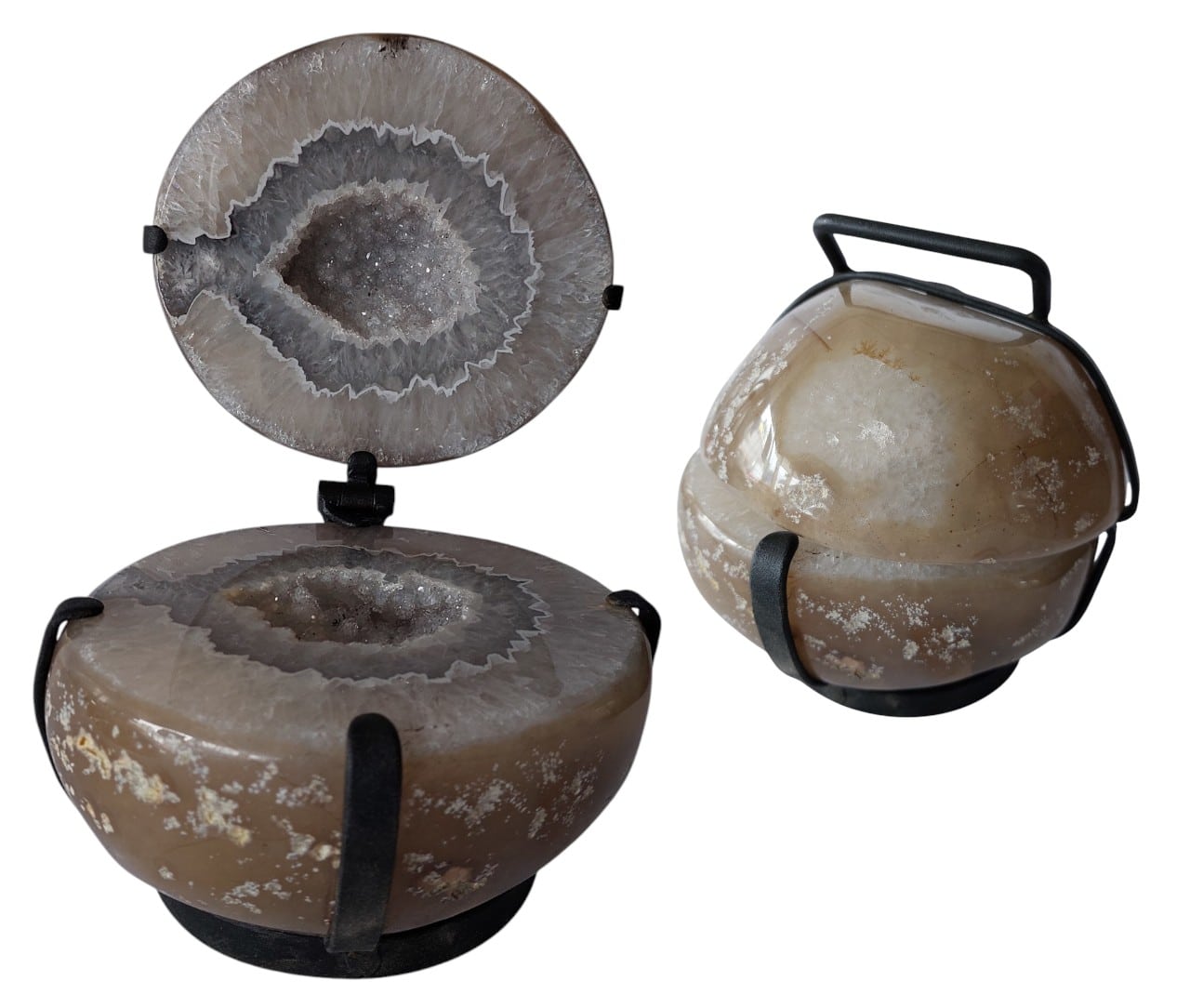
Description
Agate is a transparent, but sometimes opaque, variety of quartz and a subvariety of chalcedony. The chemical structure of agate is identical to that of jasper, flint, and chert and is often found together with opal. The colorful, striped specimens are used as semiprecious stones. The name agate comes from the Greek Ἀχάτης, Achatès, the name of the present-day Dirillo River in southern Sicily, where agates and other chalcedony were found. Traditionally, agate was worn as a lucky stone or for healing. Agate was also made into articles, such as buttons. Agate is attributed with several medicinal properties, such as protection during pregnancy, against headaches, skin conditions, and balance disorders. According to various literature, agate is associated with the zodiac signs Aquarius, Taurus, Scorpio, and Gemini. Agate compounds form as a solution of silica in cavities in older rocks. The stones can be artificially stained to achieve color combinations that are more vibrant than those found in nature. The main sources of agate are Brazil, Uruguay, and the United States (Oregon, Washington, and around Lake Superior). Closer to the Netherlands and Belgium, agate is also found in the Hunsrück region of Germany. Chemical composition: SiO₂ + Al, Ca, Fe, Mn Crystal system: Belongs to chalcedony-like quartz crystals, trigona Cleavage: None. Color: Light blue or gray, but can also be green Streak color: None Luster: Vitreous, matte, satin Hardness (Mohs): 6.5 to 7 Average density: 2.65 kg/d Transparency: Transparent to translucent


