We use cookies to make your experience better.
TimmersGems has a new website, existing customers also need to register again.
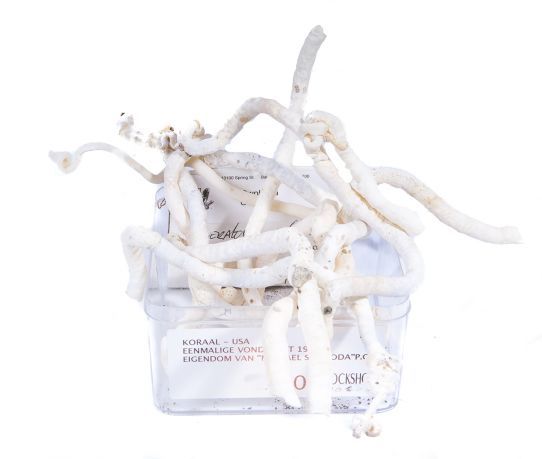


Coral USA from the famous Swoboda collection
This Coral comes from the widow of the American biologist Micheael Swoboda died in 2004, who discovered this Coral in 1937. There is only 7.8 kilo worldwide known.
Availability:
In stock
SKU
1145
- Buy 100 for €1.92 each and save 23%
Coral USA from the famous Swoboda collection is available to buy in increments of 10
Koraal is een verzamelnaam voor zeedieren van de klasse Anthozoa. Het zijn diertjes van maar een paar millimeter die, met hun tentakelkrans, wel wat lijken op een zee-anemoon, (zie ook neteldieren). Deze diertjes, ook wel poliepen genoemd, leven vaak in kolonies. Het hersenkoraal op de foto is een voorbeeld van zo’n kolonie. Koraalkolonies vormen vaak een onderdeel van koraalriffen. Binnen de klasse Anthozoa onderscheiden we twee onderklassen: de Alcyonaria en de Zoantharia. De Alcyonaria worden ook wel Octocorallia genoemd, naar de acht (=octo) tentakels die elke poliep telt. De koralen uit deze groep zijn o.a. zachte koralen: ze maken geen uitwendig kalkskelet aan. De Zoantharia, of Hexacorallia, zijn poliepen met zes (=hexa) tentakels of een veelvoud daarvan. De koralen die zorgen voor de opbouw van koraalriffen, formaties van kalksteen, behoren tot deze groep. De rifbouwende koralen zijn koloniekoralen. De poliepen uit de kolonie maken een gezamenlijk uitwendig kalkskelet aan. Dat gebeurt bovenop het skelet van overleden poliepen uit diezelfde kolonie. Zo groeien koraalriffen langzaam maar zeker. Er bestaan ook enkelkoralen: zij groeien afzonderlijk en in een eigen uitwendig kalkskelet. Tegenwoordig zijn er zo'n 4500 soorten koraal bekend.[1] Plaatselijk vormen ze grote kolonies- banken en riffen, bijvoorbeeld het 2300 km lange Groot Barrièrerif voor de kust van Australië. Koralen groeien in alle warme en schone zeeën en oceanen. In historische tijden kwamen ze veel voor in de Middellandse Zee bij Tunesië, Algerije, Italië, de eilanden Corsica, Sardinië en Sicilië. Hier komen nu nog, maar in mindere mate, de rode en oranjerode vormen voor. Koraal groeit ook in de Golf van Biskaje. Uit de Japanse Zee zijn witte koralen bekend, voor de kust van Taiwan zijn ze zalmrood, roze koralen groeien bij het eiland Midway in de Grote Oceaan, zwarte soorten bij de Hawaï-eilanden. De koralen uit de Rode Zee en de Indische Oceaan zijn beroemd, ze komen onder andere voor bij het eiland Socotra en Mauritius, evenals de zwarte koralen kabaren die zowat 3 meter lang kunnen zijn en een diameter van 25 cm kunnen hebben. Deze soort leeft ook in de Zuid-Chinese Zee en voor de kust van Cuba. Voor de kust van Kameroen werden blauwe koralen akosi ontdekt, mogelijk de zeldzaamste koraalsoort, blauwe koralen zijn ook
Koraal
beschreven aan het eiland Funafuti atol in de Grote Oceaan. Recentelijk heeft men in het noordelijke deel van de Atlantische Oceaan bij de Aleoeten en bij Alaska geel-bruine koralen gevonden. Gespikkelde koralen komen voor op een diepte van 200 meter, een bijzondere plaats wordt ingenomen door de zilverachtige-parelmoerkleurige Engelkoralen. Bloedkoraal Corrallium rubrum is het gewildste koraal. Talrijke handelsnamen bestaan, afhankelijk van vindplaats en de kwaliteit. De kleur is uniform lichtrood tot zalmkleurig Momo, middelrood Sardegna en ossenbloedrood Moro, zachtroze met witachtige of zachtroze vlekken engelhuidkoraal. Zwart koraal bestaat uit organisch hoornachtig materiaal. In de handel is het, net als blauw koraal, zonder betekenis. Het Groot Barrièrerif, noordoostelijk van Australië, bestaat uit tweeduizend kilometer koraalriffen, een bouwwerk dat op de wereld zijn gelijke niet kent. De riffen worden opgebouwd door miljoenen koraalpoliepen die mede dankzij de in hun weefsels levende eencellige algen kalk kunnen produceren. Rifbouwende ondiepwaterkoraalpoliepen (bijvoorbeeld hersenkoraal - Colpophyllia sp.) treft men aan in helder zout water met een minimale temperatuur van 20°C. Ze ontbreken aan de oostzijde van de grote oceanen door de daar heersende koude stromen en daar waar slibrijk water door rivieren wordt aangevoerd. Er kunnen drie riftypen onderscheiden worden: het kustrif, het barrièrerif en de atol (zie ook koraalrif). Rifbouwende koudwaterkoralen (Lophelia pertusa) vindt men van 200 m tot 2000 m diep. Koralen planten zich zowel geslachtelijk als ongeslachtelijk voort. Door stress en verstoring van de leefomgeving vindt de geslachtelijke voortplanting vaak niet meer plaats, terwijl dit uitermate belangrijk is voor genetische diversiteit van koraal en dus voor het behoud van de koraalriffen. Diergaarde Blijdorp in Rotterdam is betrokken bij diverse onderzoeksprogramma's om er voor te zorgen dat de geslachtelijke voortplanting beter verloopt, zowel in aquaria als in de natuur. Koraal is genoemd naar het Latijnse woord coralliu, respectievelijk het Griekse woord korallion.
FEATURED PRODUCTS